Family Proteaceae.
Originating from Australia.
- Cascading branches rise and fall, making a low, undulating ground cover.
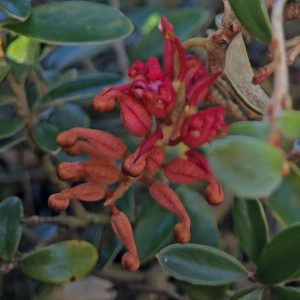
- Soft, yellow-apricot-coloured, spidery flowers smother the plant for months.
- Easy to grow in sun or part shade, evergreen and drought-tolerant.
The Prostrate Yellow Grevillea in Your Garden
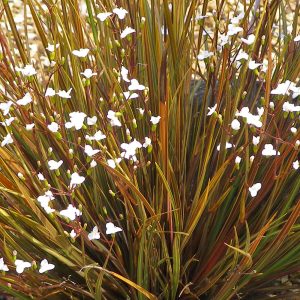
Dark evergreen rosemary-like foliage is borne on a mass of ground-hugging branches. Gracefully arching, they rise and fall, creating an undulating carpet. Its foliage and form set the stage for a uniquely coloured and intricately structured display of flowers. Their display lasts all summer and autumn, and as with all grevilleas, they attract droves of pollinators.
Hardy in southern and coastal UK gardens, Grevillea juniperina f. sulphurea prostrate grows to 30cm tall and 1m wide. It attains these dimensions in 5-10 years, even under trees in dry part shade. Rambling below pittosporums and acacias in Suffolk’s antipodean planting schemes, it adds a green carpet with glowing flowers. Alternatively, it thrives in the sun-baked coastal climates of Norfolk’s Mediterranean-style gardens.
Known as ‘Spider Flowers’, grevilleas have unique blooms, with long styles protruding from clusters of tubular petals. Identifying their flower colour is difficult; in strong sunlight, they appear fiery yellow- orange, in overcast conditions, peach and tan. Their delicate, complex form is matched by their elusive colours, making the prostrate yellow grevillea a fascinating and unique plant.
Did you know?
Aboriginal people used nectar-rich Grevillea flowers to make a sweet tea or tapped them on their hands to release a sugary, energy-boosting snack.
Growing Tips for Your Spider Flower (Grevillea juniperina f. sulphurea prostrate)
- Soil and sun: Any well-drained, non-alkaline soil in full sun or part shade.
- Planting: from spring to autumn. Never plant a dry plant! Plunge the pot into water to thoroughly drench the rootball before planting.
- Watering: Water regularly until established. Drought-tolerant once rooted.
- Pruning: Trim lightly after flowering to maintain shape and encourage bushiness. Hard pruning is not advisable.
Hailing from a small area in Western Sydney and the surrounding areas, its natural habitat is threatened by development. Originally found in eucalyptus woodland, this species may soon only exist in cultivation. Grevillea juniperina was introduced to the UK in 1820 and offers waterwise gardeners a tough, resilient plant. Furthermore, the nectar-rich flowers of the yellow Grevillea provide a valuable food source for wildlife gardens.