Family Asteraceae
Originating from South Africa.
- Evergreen spreading carpets with toothed green leaves make a fantastic ground cover.
- Brilliant soft orange flowers make an intense display all summer.
- Surviving mild winters in southern and coastal gardens, easy to grow in any free-draining soil.
The low spreading branches of this woody perennial bear pointed lanceolate evergreen leaves that are often obscured when the plant is in full flower, due to the profuse display of blooms. It forms soft mounds of foliage capable of spreading to cover one square metre in a hot summer, or more if the plant overwinters. The foliage grows densely enough to obscure the woody stems, making an undulating rounded shrubby shape, ideal for creating bushy ground cover.
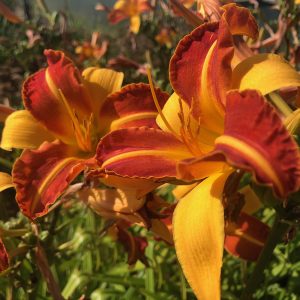
Warm, rich golden/orange flowers appear in masses all summer long, making a billowing carpet of blooms. Each petal is warm yellow near the centre of the flower, gradually turning orange near its outer edge, appearing to radiate warmth. They are great pollinators, attracting butterflies in particular, as well as any passing pollen-hungry insect. The long flowering season can be weather-dependent, depending on when planted and the season; if planted early, as soon as the frosts are over, it may flower immediately in a warm spring, and then produce a later flush. In our garden at Urban Jungle Beccles, in Suffolk, plants that overwintered flowered in February and right through a mild spring, they took a break during a very hot summer and then produced a spectacular flush heading into autumn.
This adaptable species suits many styles, underpinning exotic plantings of Musa lasiocarpa, Buddleja speciosissima, and Echium candicans or Echium pininana. It can make a loud and soft mound of colour around spiky plants in Mediterranean-style gardens softening the impact of Cordyline ‘Torbay Dazzler’, Kniphofia ‘Sunningdale Yellow’ and Agave salmiana var. ferox. Its adaptability to growing in pots, raised planters and rockeries means that selected colours, used in repetition can be used to great effect in contemporary gardens, or conversely added to a riot of colour in English garden-style borders.
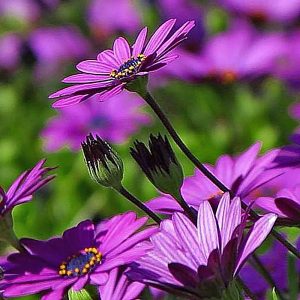
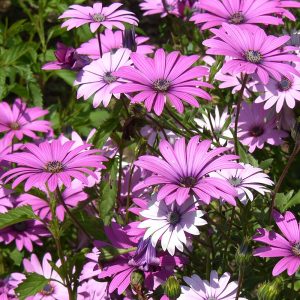
In southern and coastal gardens this outstanding African Daisy will survive mild winters, sometimes for several seasons. In northern and inland gardens it may survive if given protection during mild winters or can be treated as an annual. Usually available as small plants, the outstanding performance of Osteospermums needs to be weighed against their cost; even if lost in some winters, they are great value for money, even if only for one season
Height and spread after 1 – 2 years 40cm x 60cm.
Potential height and spread after 2 – 3 years 40cm x 1.2m