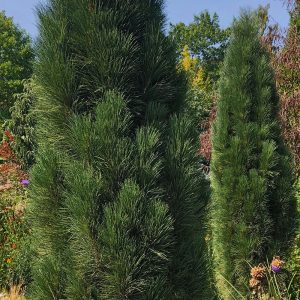
Sciadopitys verticillata, 3L plants
Family Sciadopityaceae.
Originating from Japan.
- Received the Royal Horticultural Society’s Award of Garden Merit.
- A unique and beautiful pine when young, growing into a serene tree in maturity.
- Slow growing and evergreen, its youthful character can be enjoyed for many years.
- Grows well in light sandy or humus rich woodland soil in full sun
Sciadopitys verticillata characteristics
Possibly the cutest pine on the planet when young, with unique, beautifully arranged graceful whorls of needles radiating from around the branches. Most pine needles grow in fascicles (bunches) of 1 to 5, whereas Sciadopitys needles are arrayed like umbrella spokes, perhaps the source of its common name ‘Japanese Umbrella Pine’. Each needle grows initially upright, yet gracefully curving outwards from the stem giving their circular array a brush-like appearance. As they mature they droop elegantly downwards, being somewhat reminiscent of a sea anemone.
Its youthful character may be enjoyed for many years due to its slow growth, while it attains a small shrub size until it becomes a 2 – 3m tall plant, over a period of 10 or 20 years. As the plant’s sheer mass of foliage, and developing tree-like form become evident, these aspects of the species become its foremost qualities, bestowing a serene and ancient appearance. The maturing trunk begins to reveal its rich cinnamon red coloured bark, peeling, with vertical fissures, contributing to the tree’s rarefied countenance.
The History and Cultural Background of The Japanese Umbrella Pine.
One of the five sacred trees of Kiso in Japanese culture, it is frequently planted around temples, (see our gallery photo of a tree thought to be many hundreds of years old at Koden-ji temple in Nerima City, Japan). Its highly prized timber is used in the construction of Shinto temples and was once reserved for imperial use; it is light in colour and watertight, and was used for ship building and for casks, as well as for furniture.
The genealogical record of Sciadopitys verticillata can be traced back 230 million years, and its evolution during that time has remained singular; it has no relatives, belonging in its own family of one species, which is the source of its many aesthetically, as well as botanically unique characteristics. Few other trees have such an evolutionary path, Ginkgo biloba and Wollemia nobilis, the Wollemi pine being two such species, which are often referred to as having ‘reached an evolutionary dead end’, or ‘dinosaur plants’.
For a full and fascinating account of Sciadopitys verticillata’s history go to –
https://www.treesandshrubsonline.org/articles/sciadopitys/sciadopitys-verticillata/
Planting suggestions, using our Japanese Sciadopitys verticillata 3L Plants.
Unless you plan to let this wonderful species develop naturally in its own space, perhaps in a large garden where one might even plant a ‘stand’ of several plants, we recommend having a plan for how you want it to develop. By using the Japanese practice of Niwaki it is relatively easy to control the development of Sciadopitys verticillata, making it possible to plant it in smaller gardens, and in compositions with other plants. Knowing that relatively simple pruning practices will allow you to add this special pine (and other larger growing species) in this way, so that both its young and mature characteristics can be enjoyed, is liberating in garden planning, opening up a range of possibilities.
If you are prepared to use ladders and allow it to reach 3 or 4m tall, or higher, depending on how high you want to climb, it could be planted to create shade in a woodland style garden, giving protection to plants like Acer palmatum ‘Bi Ho’, Acer palmatum ‘Katsura’ and Acer palmatum ‘Atropurpureum’. These species will in turn provide shelter for ferns such as Dryopteris erythrosora, Dryopteris cycadina and Polystichum munitum.
One of the greatest pleasures in gardening is planning for the evolution of planting compositions, and the slow growth of Sciadopitys needs to be considered in the scenario of planting it for shade or shelter giving, or screening, where it should be planted well in advance of adding plants needing shade. At an eventual size of 3m or above it could also be used as a centre-stage specimen with low growing plants around it such as Astelia ‘Red Shadow’, Astelia ‘Silver Shadow’ or Pittosporum tenuifolium ‘Silver Ball’.
If you plan to use Sciadopitys verticillata in a smaller space to create an oriental style garden it could be trained to form a serene, architectural specimen, perhaps with a backdrop, such as the ‘Temple Bamboo’, Semiarundinaria fastuosa, or Phyllostachys aureosulcata f. Aureocaulis. Underplanting can be carried out using very low growing species that might form a carpet spilling over or around rockery stones at the base of the pine such as Ophiopogon planiscapus nigrescens, Epimedium x youngianum ‘Roseum’, Epimedium x warleyense, or Armeria maritima ‘Rubrifolia’.
Successfully Growing Sciadopitys verticillata.
As mentioned above, Niwaki techniques can be used to increase the versatility of this species. Niwaki involves a wide range of techniques from wiring branches to creating frames for training, and cloud pruning, to name a few. However, the methods required to shape your Japanese Umbrella Pine need not be so complex, employing pruning techniques that could loosely be called Niwaki. These should only be initiated once the tree is well established and has developed a strong leader (dominant shoot at the apex of the plant’s cone shaped crown). At this stage lower branches can be removed to reveal the developing trunk, selected side branches can be cut entirely or partially back to create tiered crown, and the leader can be removed to encourage lateral, rather than vertical growth.
Sciadopitys, like many plants, can take 2 – 3 years to establish before starting to grow strongly and attain a fully healthy demeanour. It seems to be a species that needs time to adjust to its new soil conditions and climate and during this period it appreciates some shade, and light, sandy humus rich, non alkaline soil with plenty of moisture. You can expect Sciadopitys verticillata 3L plants to mature and become more robust, adapting to dry, hot spells, and as the roots spread, possibly encountering poorer or heavier soil or subsoil. It thrives around the Italian lakes in hot Mediterranean summers and is found growing in rocky crevices in mountainsides in Japan. It is able to withstand temperatures of -30 degrees.
From planting Urban Jungle’s Sciadopitys verticillata 3L plants one can expect approximately the following growth rate if the plant is not pruned:
Height and spread after 10 – 20 years 3m x 1.5m
After 20 – 50 years 8m x 3m, potentially reaching 25m x 10m in great maturity, after 70 years plus.