Family Fabaceae
Originating from Japan.
- Vigorous woody twining stems support lush, feather-shaped leaves.
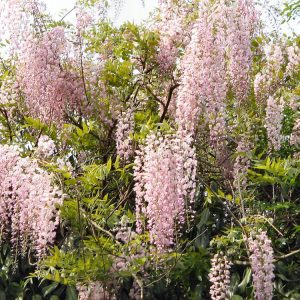
- Abundant tassels of scented pink to white flowers bloom in summer.
- Hardy and easy to grow in any soil as a climber or shrub.
The silky wisteria’s incredible display of enchantingly delicate pink to white flowers creates a serene vision. Enjoy them close-up; plant around a Norfolk townhouse front door or Suffolk farmhouse pergola arches to fully appreciate their scent and intricate form.
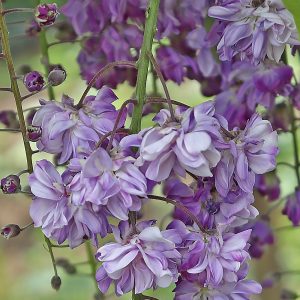
The many hundreds of individual blooms have a complex structure, ranging in pendulous tassels from pergolas or arbours. Their large banner petal is a pale white to lilac, whereas the smaller wing petal is darker pink-violet.
After flowering, Wisteria brachybotrys produces large, silky seed pods, hanging amongst its lush foliage. Give its canopy of large feather-shaped leaves room when considering overhead structures. They are great shade providers, making a perfect, cool midday setting for contemporary outdoor sofas and traditional sun loungers. Easily controlled, any long shoots can be trimmed after flowering has finished. Reaches up to 9m in 10 – 20 years if not pruned.
Care Tips for Silky Wisteria
- Soil and Sun: Full sun produces the best flowering display, part shade may produce fewer flowers and lusher foliage.
- Planting: Plant at any time of year, soak the root ball by plunging before planting.
- Watering: Water thoroughly after planting, allowing the soil to dry out between waterings during its first year. Deep-rooted and tolerant of dry conditions once established.
- Pruning and Training: Provide wires or robust trellises for walls. On pergolas, tie in early shoots on young plants before they twine and support themselves.
This most delicately coloured of wisteria species is normally regarded as a specimen for Traditional English gardens, requiring a large amount of space. However, it is easily pruned to any shape, including a standard shrubby specimen. Controlled in this way it is suitable for small city gardens in Norwich, Norfolk and Suffolk courtyards. Its adaptability and hardiness make it ideal for even exposed UK gardens.
Planting Suggestions for Wisteria brachybotrys
Dramatise the ethereal soft colours of this species of wisteria by standing a pot-grown specimen, trained as a shrub, amongst purple-leaved plants. Cercis canadensis ‘Ruby Falls’ and ‘Forest Pansy’, Pittosporum ‘Tom Thumb’ and Physocarpus ‘Diabolo’s dark hues create the perfect contrast.
A healthy Wisteria brachybotrys can produce a second flush of blooms in favourable summer seasons. Plant Clerodendrum trichotomum and Cotinus ‘Grace’ and ‘Flame’ in borders near pergolas where it is growing. Vitex trifolia ‘Purpurea’, Buddleja davidii ‘Black Knight’ and Weigela florida ‘Minor Black’ will also complement its late-season flourish.