Family Rosaceae.
Originating from Western & Southern Europe, Northern Africa, Western Asia.
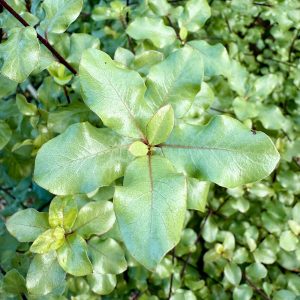
- Glossy evergreen leaves with purple-red stems form a dense, neat canopy.
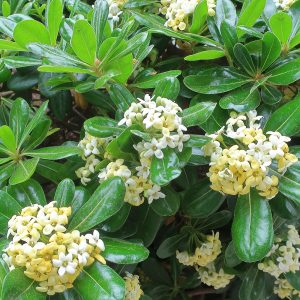
- White fragrant flowers bloom in summer, followed by black berries.
- Easy to grow and drought-tolerant when established
Portuguese Laurel in Your Garden
Refined and ornamental, this cultivar offers a neater, denser habit than the species. Prunus lusitanica ‘Myrtifolia’s smaller, slender, glossy evergreen leaves and compact habit make it ideal for clipping. Its striking red-purple young stems add colourful detail to a polished, architectural display.
Hardy in all UK gardens, it reaches 3m high and wide in 10–20 years, flourishing in well-drained soil. Drought-tolerant once established, it is the perfect architectural coastal evergreen shrub for Norfolk’s exposed seaside areas. Equally happy in part shade, it makes a great evergreen foil for deciduous plants in Suffolk’s woodland gardens.
Easy to grow, it tolerates wind, salt, annual clipping to any shape and hard pruning once established. Its fragrant, sweetly scented white flowers attract pollinators and gardeners alike. Birds love its black berries that follow and its dense crown for nesting; perfect for both waterwise and wildlife gardeners.
Growing Tips for Your Myrtle-Leafed Laurel.
- Soil and Sun: Plant in well-drained soil; full sun or part shade is ideal.
- Planting: at any time of year. Never plant a dry plant! Plunge or stand in water for 15 minutes to drench the root ball before planting. Water regularly in its first summer while rooting out.
- Watering: Moderate; tolerates drought once well established. In pots, drench thoroughly weekly & feed bi-weekly in summer.
- Pruning: Clip after flowering to shape; remove dead wood. If hard pruning is required carry out in spring.
Adaptable to any style and a wide range of growing conditions, this invaluable architectural coastal evergreen also fulfils multiple roles. It carries out utilitarian roles with aplomb, adding a touch of style to hedges and screens.
Planting Ideas: for the architectural coastal evergreen shrub, Prunus lusitanica ‘Myrtifolia’
Make a serene space with statuesque specimens, or be embraced by free, flowing organic forms. Large evergreen species that form hedges or screens offer a world of possibilities for creative garden sculpting. Contemporary or traditional, they needn’t be cliche animal or standard cones and pompoms. Grislinea ‘Green Horizon’, Pittosporum ‘Silver Queen’, ‘Garnettii’, heterophyllum, and ‘Irene Patterson’ can all make tight, compact shapes if trimmed regularly.
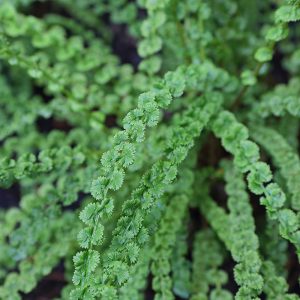
In addition to the larger, enclosing species above, there are numerous smaller mound-forming varieties. Some naturally form undulating compositions without clipping, like Pittosporum ‘Beach Ball’, ‘Golden Ball’, tobira ‘Nanum’, ‘Bannow Bay’ and ‘Gold Star’. They can soften more intimate spaces, providing structure amongst herbaceous plants alongside Muehlenbeckia astonii and complexa.